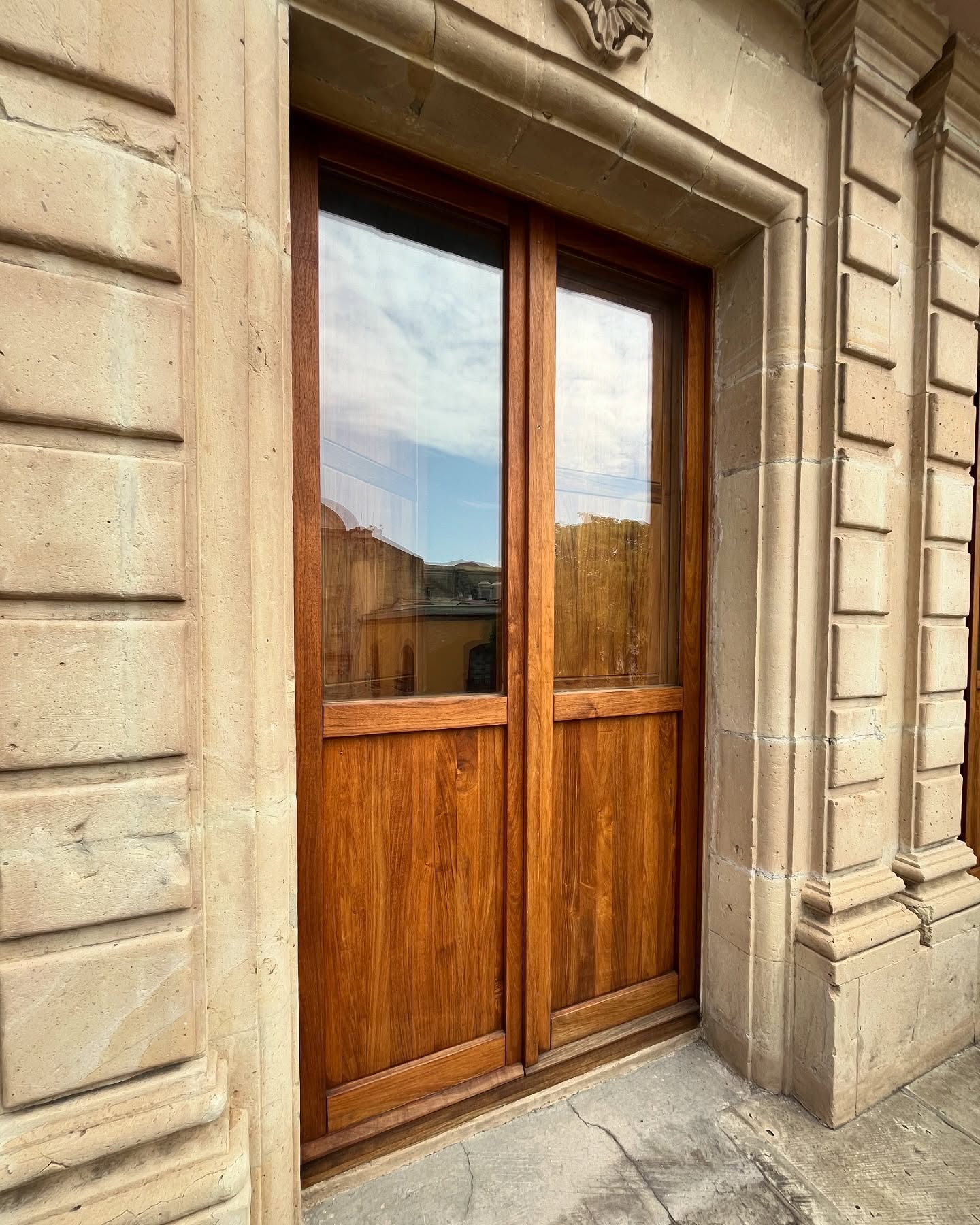
JOURNAL / DOORS
Both swing to open, but differently. A hinged door hangs from hinges on one of its edges; a pivot door turns on a floor pivot and a top pivot set in from the edge of the leaf. That difference changes the size each can take, how it looks when open and what it costs.
When a pivot door makes sense
- Large leaves. It takes wider, taller and heavier doors than hinges can.
- Entrances that take center stage. Open, the leaf stands perpendicular to the opening and splits the passage in two.
- A single leaf in a wide opening, without splitting it into two doors.
When a hinged door makes sense
- Interiors, bathrooms and bedrooms, where the opening is a standard size.
- When the best seal matters: it closes against its frame all around, with gaskets.
- When cost matters: its hardware is simpler, and so is installation.
- Wide entrances can also be solved with two hinged leaves.
What a well-made pivot door needs
A large leaf has to stay straight for years: it calls for stable wood, such as tzalam, and sections designed so it doesn’t warp. The floor pivot is chosen for the leaf’s weight and carefully leveled on site; on the coast, the hardware must also resist corrosion. If it has glass, double or triple safety glazing is the way to go.
As a reference, a solid wood front door runs MXN 50,000 to 95,000 before VAT and freight; a large pivot door usually lands at the upper end because of its hardware and size.